The Collection
The Dates He Wrote Down
September 15, 2026

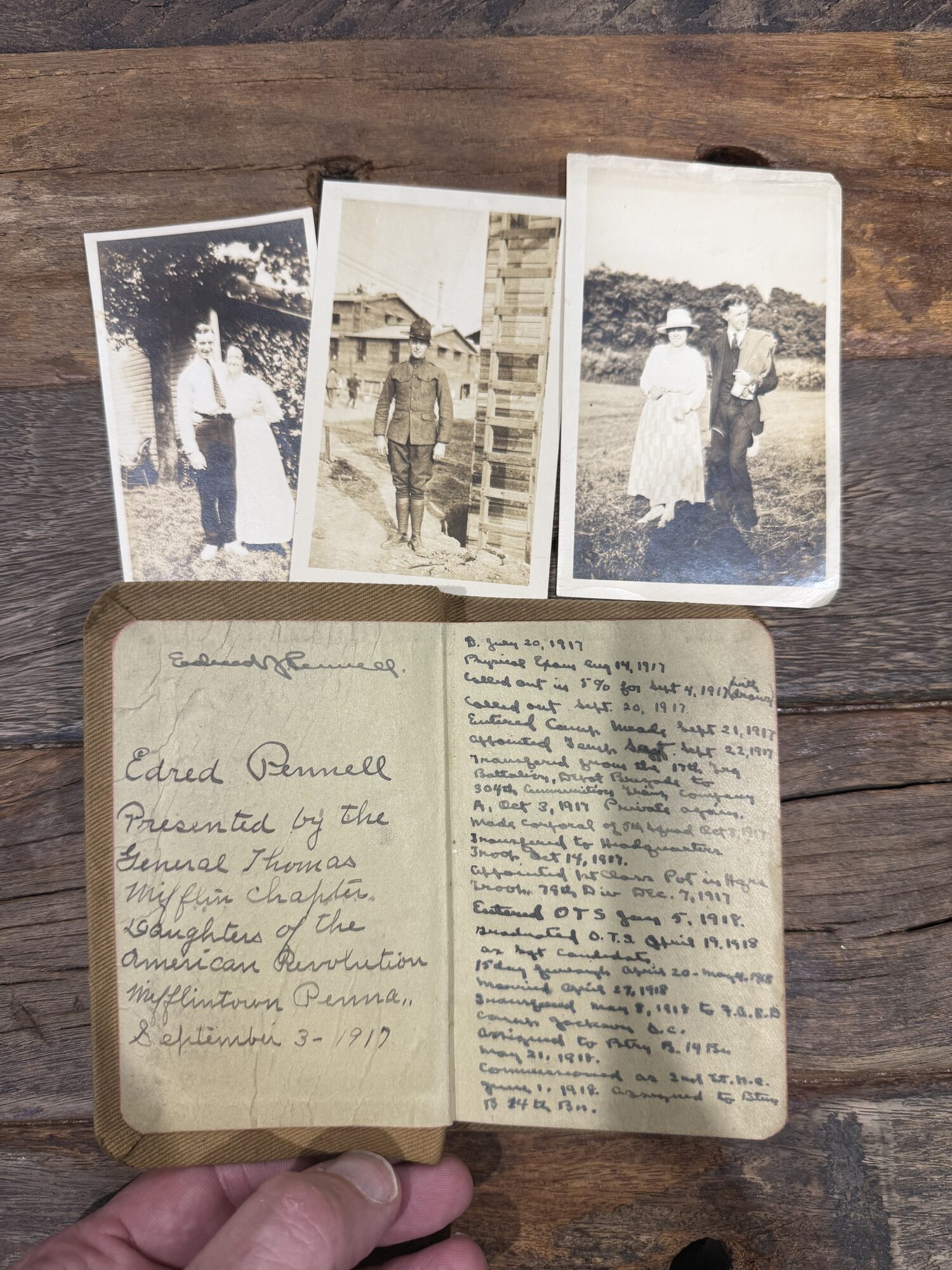
On September 3, 1917, the women of the General Thomas Mifflin Chapter of the Daughters of the American Revolution pressed a small book into the hands of a 26-year-old named Edred Pennell. In Mifflintown, Pennsylvania, the Daughters sent the local men off to war with a pocket Testament, and Edred was on his way. His physical was already behind him. In seventeen days the Army would call him out.
He carried that Testament through all of it. Camp Meade. The 304th Ammunition Train, where his sergeant's stripes came off and he was a private again before he made corporal. Headquarters Troop of the 79th Division. Officers' training. And on June 1, 1918, a commission: Second Lieutenant, Field Artillery.
We know all of this because he wrote it down. In the front of the book, in his own hand, Edred kept the record of his war. Every transfer, every rank, every date. A man keeping the minutes of his own life while the world came apart around him.
That is not the part that stops me.
Thumb through the pages and you find more of his handwriting, smaller, tucked into the margins beside certain verses. Dates. He was marking the day he read a line. Not a diary, not a letter home. A quiet note to himself that on this day, in this place, these words met him where he was.
I do not know what he was carrying on those days. Nobody does now. But I know what the book became. In the middle of a war, a young man kept coming back to the same pages, the way you return to a place that steadies you. One line in it reads like a promise made straight to a soldier:
"Come unto me, all ye that labour and are heavy laden, and I will give you rest."
Matthew 11:28
Edred did more than underline a line like that. He wrote down the day he read it.
Photographs were still tucked inside the book when it reached me. One is Edred in uniform at camp. Another is Edred and Ruth, his bride, in white. They married on April 27, 1918, on a fifteen-day furlough between his training and his commission. He went back to the war carrying a picture of the best day of his life pressed against the pages he read to stay steady.
Here is what a man like Edred understood that a lot of leaders miss.
He spent that entire year in service. He went from sergeant back to private, then earned his way up to an officer's commission. Service was the whole shape of his life. And still, in the middle of it, he stopped. He opened the book. He read a line and wrote the date beside it. He kept his own soul filled.
Leadership is service. I believe that all the way down. But you cannot hold the rope for someone else if you have let go of your own. The people counting on you do not need a leader running on empty and proud of it. They need one who has done the private, unglamorous work of staying whole. Edred Pennell held the rope for his country and his men. He also, quietly, held it for himself.
He came home. He and Ruth raised three children. He lived until 1949 and was buried in Mifflintown, the same town whose Daughters had handed him the book thirty-two years before. The Testament outlived him. The dates are still there in the margins, waiting.
Serve others with everything you have. Then find your resting place, and write down the date.
Bring this to your team.
Check availabilityThe Collection
Get the next one in your inbox.
One artifact a week, and what it taught me about leading by service. Leave whenever you like.