The Collection
Under His Father’s Name
October 27, 2026
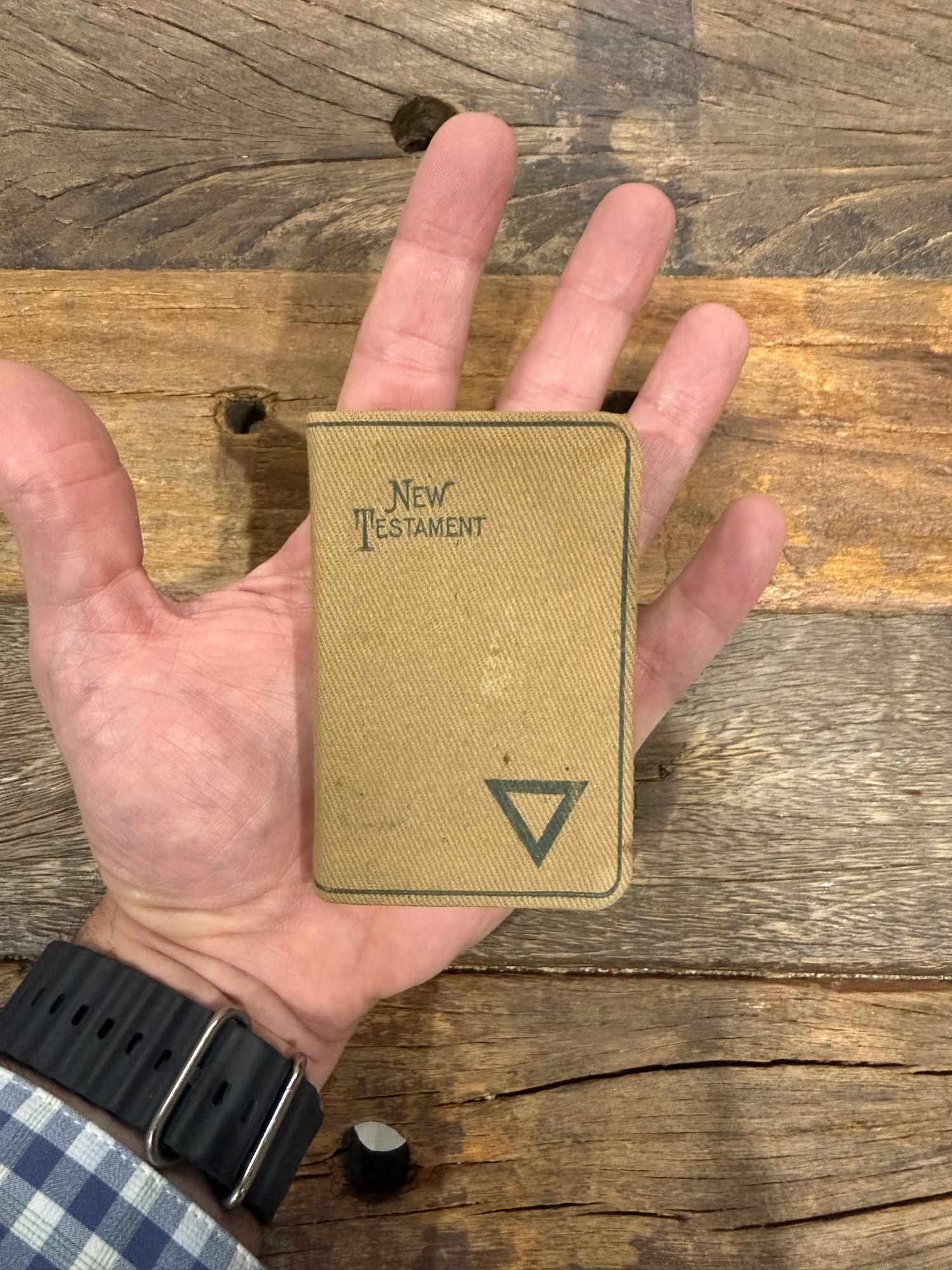
I have found dozens of Bibles carried by soldiers in World War I. I bought this one at a World War I auction, and it holds something I had never seen.
It is a small New Testament with a khaki cloth cover, printed by the American Bible Society. The triangle on the front is the mark of the YMCA, which handed these out to men going into the service. Inside the cover is a printed form: Name. Address. Service.
On the name line someone wrote “R.F. Ballinger 1918.” Under it, in a different hand: “Francis Edwin Ballinger 1943.”
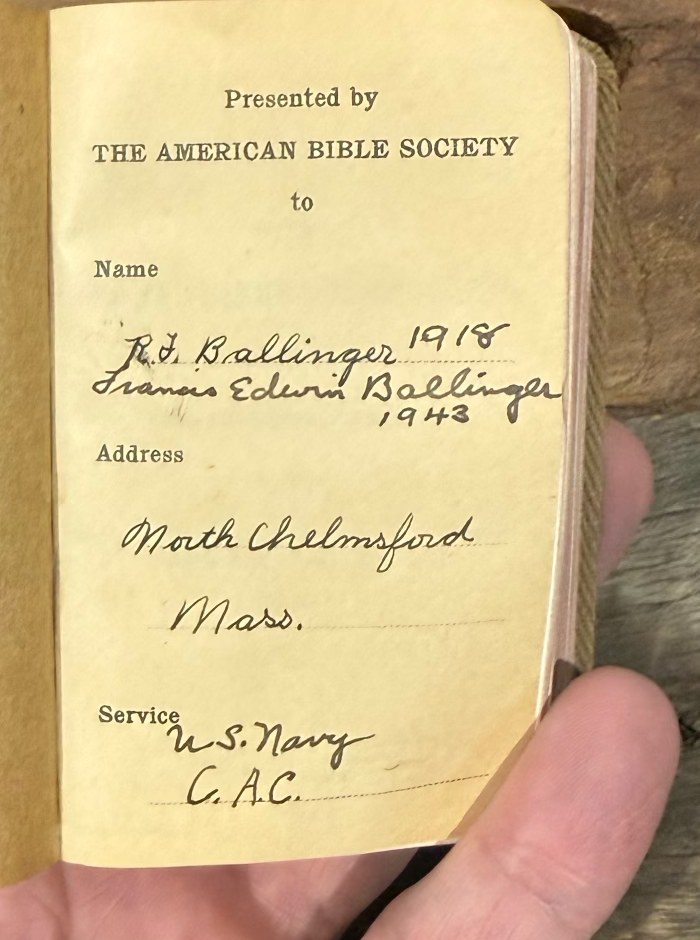
A father carried it in the first war. His son carried it in the next one.
The father was Raymond Francis Ballinger, born in Woonsocket, Rhode Island, in 1897. His father, William, came from Bradford, England, the wool capital of the world, and the family ended up in the mill town of North Chelmsford, Massachusetts. In the summer of 1918 Raymond lived on Cottage Row and worked for the U.S. Worsted Company at the Silesia Mill. He registered for the draft on August 24. The registrar wrote down medium height, slender, brown eyes, brown hair.
That year was hard on his family. His sister Ethel had died the November before, at 24. On October 15, 1918, his sister Alice died of pneumonia in Bristol, New Hampshire. She was 31. She left three little girls, and the youngest was born that year.
Six days later, Raymond was inducted into the Army.
He went to the 14th Company of the Coast Artillery Corps at Fort McKinley, on an island in Casco Bay guarding Portland, Maine. That is the “C.A.C.” on the service line. On November 6 he was sent to the Coast Artillery School at Fort Monroe, Virginia. Five days later the war ended. He was honorably discharged on December 23, a private.
Sixty-three days. He never saw France. He buried one sister and lost another, and he reported for duty anyway.
He came home, married Edna Biggar in Chelmsford in 1919, and went back to the mills. He kept the book.
Their son was born in 1925, and they named him Francis, his father’s middle name. In 1940 three generations lived under one roof in North Chelmsford: Raymond, Edna, their two children, and Raymond’s father, William, who was 78.
In 1943 Francis turned eighteen. The country was at war again. He took his father’s Testament and wrote his own name on the line under his father’s. The service line holds both of them now: “U.S. Navy” for the son, “C.A.C.” for the father.
Francis served as a Carpenter’s Mate Second Class. His name is on Chelmsford’s World War II Honor Roll. When the census taker came in 1950, father and son were living in the same house and both working in wool combing, Raymond as an assistant superintendent and Francis as a comber.
They are buried side by side in Riverside Cemetery in North Chelmsford, under one family stone.
Most of the books in my collection tell me about one man. This one tells me what a father hands down. Raymond did not hand his son a speech about duty. He handed him a book with his own name already in it, and the example of a man who showed up the week it cost him the most.
Leadership is service, and the best of it gets handed down. Your kids will not remember what you said about showing up. They will remember whether you did.
“But as for me and my family, we will serve the LORD.”
Joshua 24:15 (NLT)
The line on that page was printed for one name. The Ballingers made it hold two.
The Collection · PDF
Keep this one.
Get “Under His Father’s Name” as a printable PDF, with the photographs. Enter your email and it downloads now. You’ll also get the rest of the collection by email, one piece at a time.
Keep reading
More from the writing
Bring this to your team.
Check availability