The Collection
Come and Go
October 17, 2026
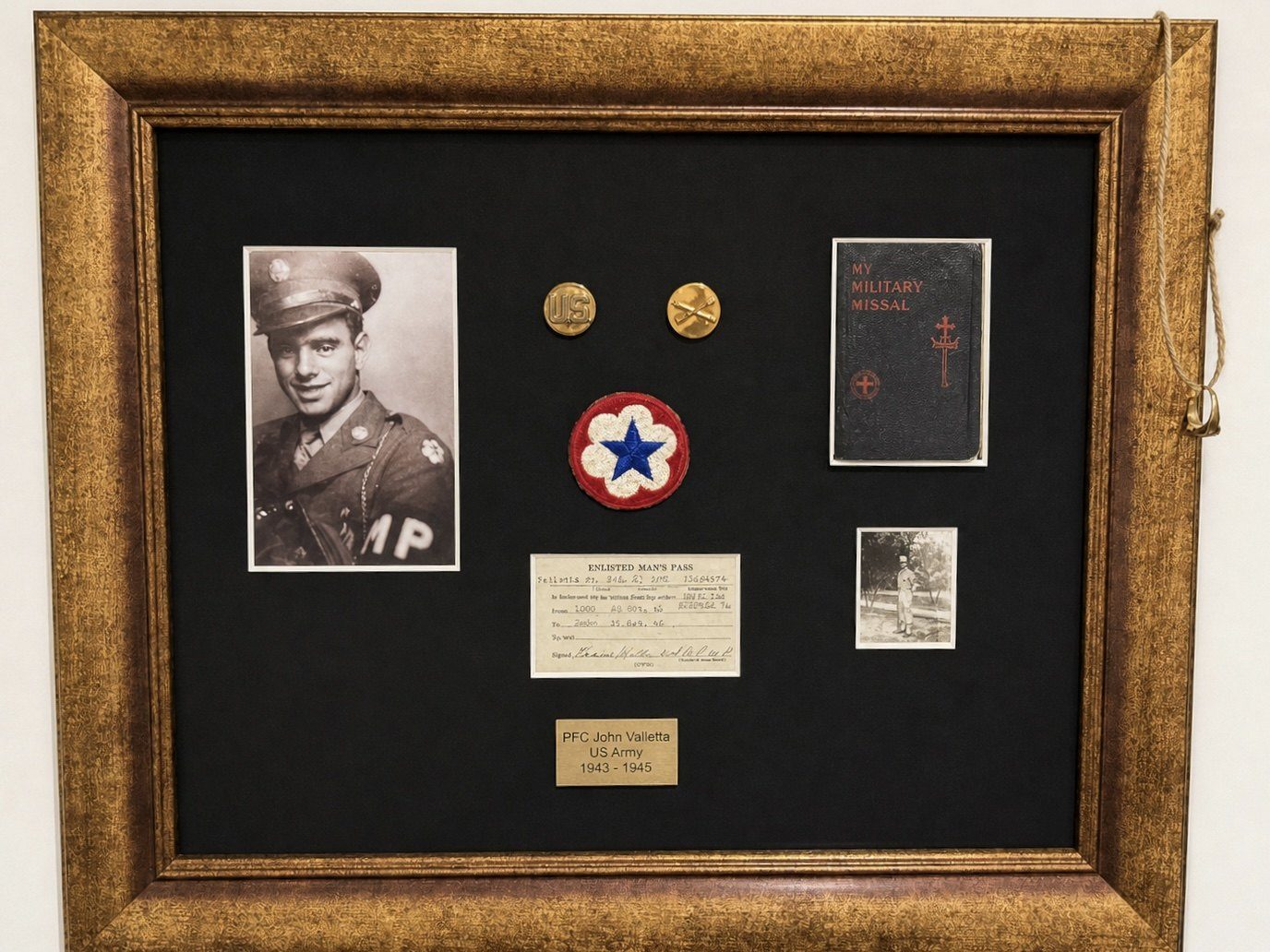
Of everything in my collection, this is the piece I value most. It is one frame. The soldier in it is my grandfather, John R. Valletta Jr. I never met him. He died on July 11, 1963. My dad was eleven.
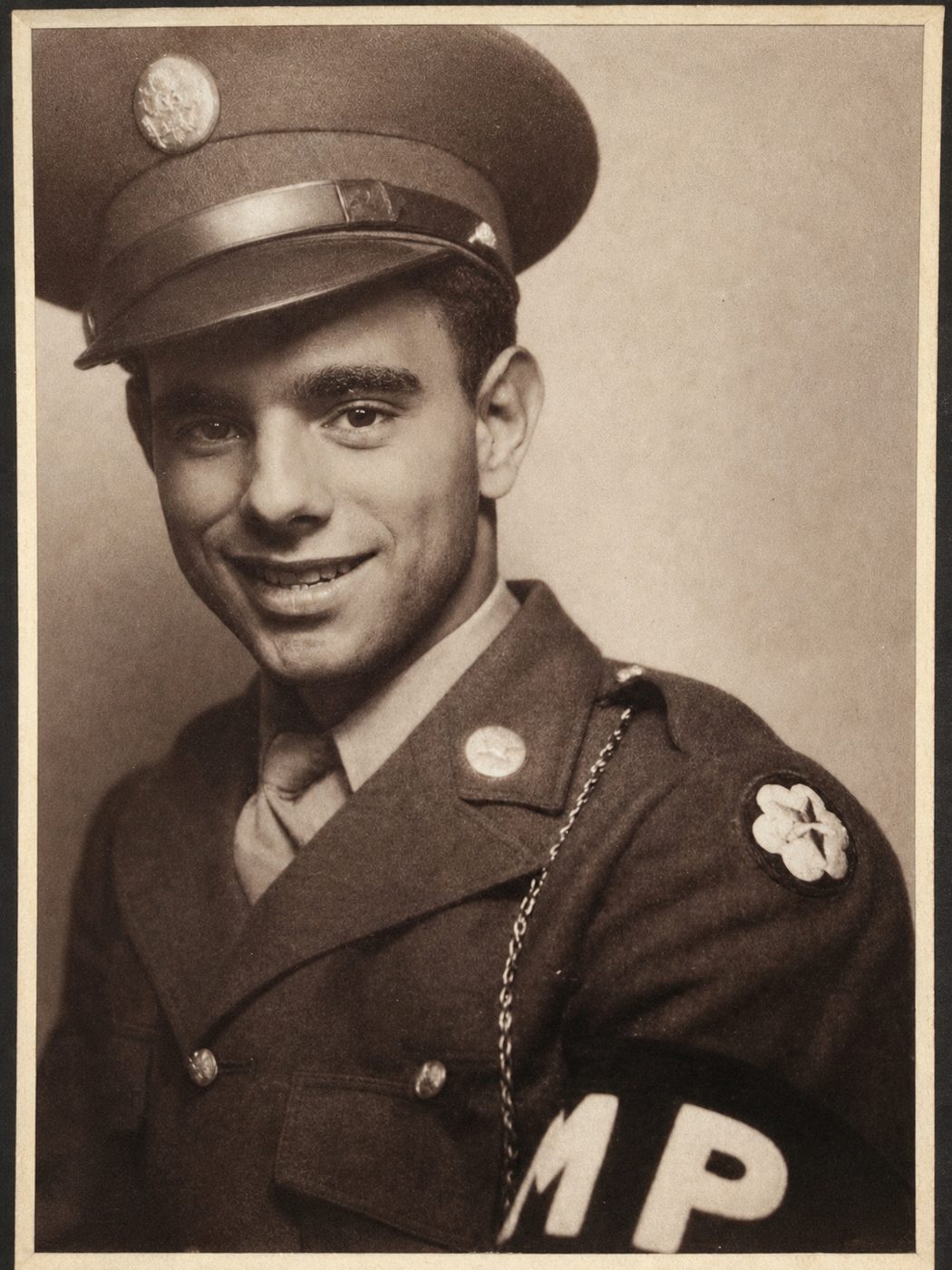
Inside the frame are two photographs of a young MP, two brass collar discs, a cloth shoulder patch, a small black Catholic prayer book, and a typed card about the size of an index card. A gold ring with a red stone hangs beside it.
When I started collecting, my dad gave me these things for my birthday. I had them framed together. For years that was enough. This year I went looking for the man inside the frame.
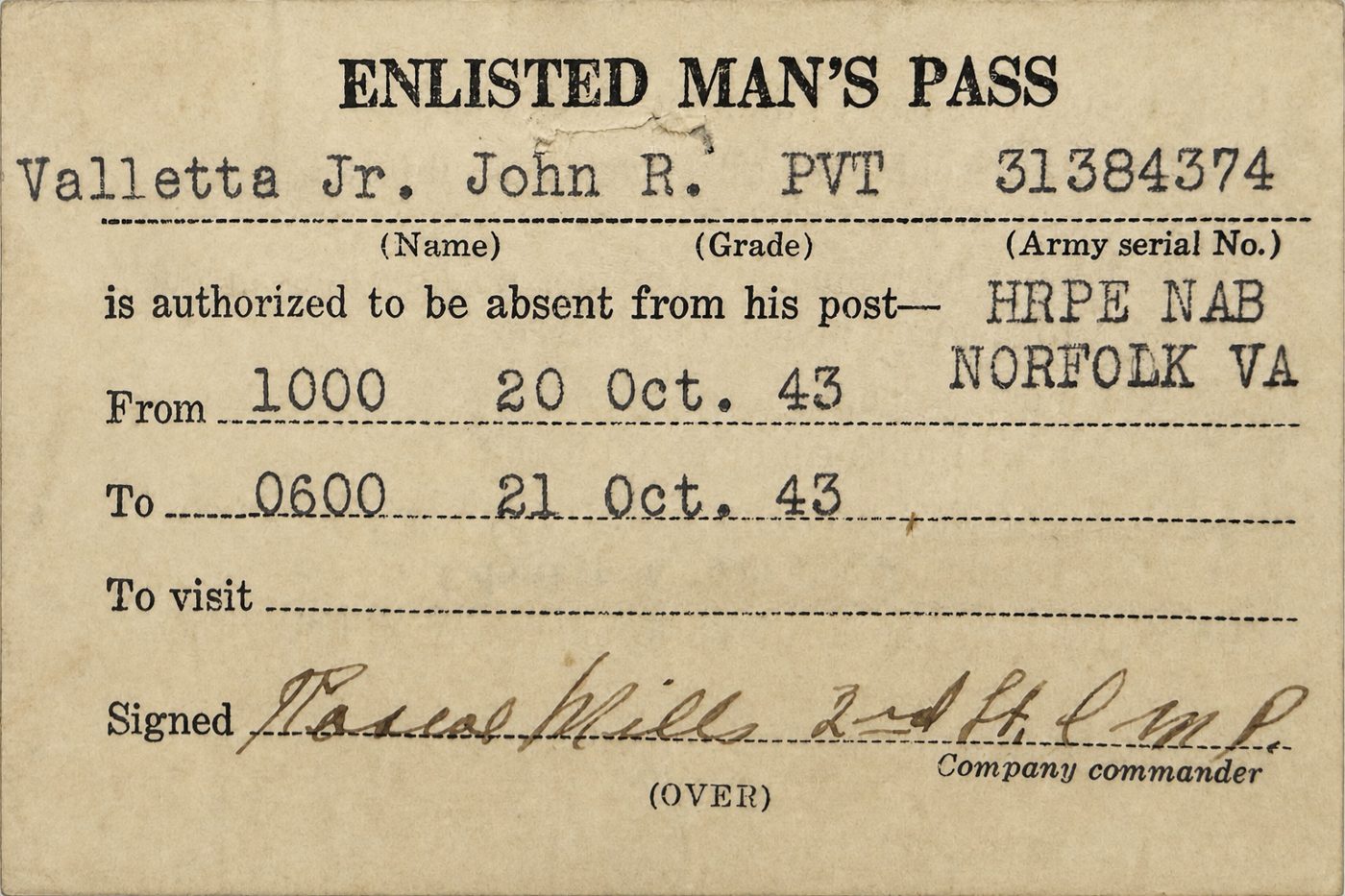
The card is an Enlisted Man’s Pass. It says Private John R. Valletta Jr., Army serial number 31384374, was authorized to be absent from his post, HRPE NAB, Norfolk, Virginia, from ten in the morning on Wednesday, October 20, 1943, until six the next morning. Twenty hours. A second lieutenant of the Corps of Military Police signed it as his company commander.
The serial number opens his file at the National Archives. A first digit of 3 meant a draftee, and the 1 after it meant New England. His enlistment record says he was inducted at Providence on May 31, 1943. He was born in 1925. He had three years of high school, no wife and no dependents. On the night of this pass he was eighteen, not quite five months in uniform. He served until 1945 and finished a private first class.
HRPE was the Hampton Roads Port of Embarkation. NAB was the Norfolk Army Base, one piece of it, built in 1917 to ship supplies to France. By the Army’s own count, more than 760,000 people and nearly 13 million tons of cargo went out through Hampton Roads during the war. Tanks, ammunition, food, and men for North Africa, Sicily and Italy. The piers are still working today as Norfolk International Terminals.
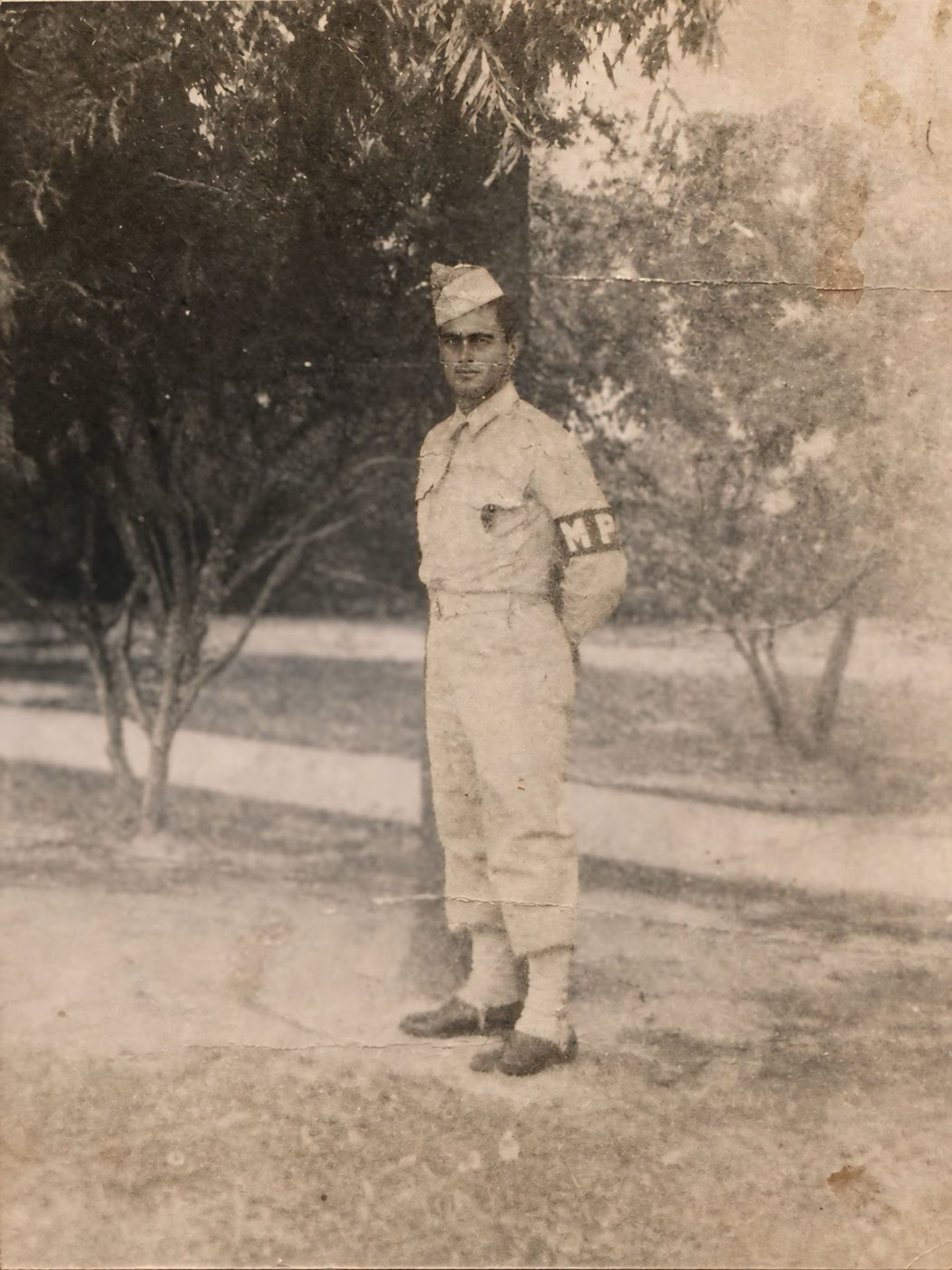
He was an MP at that port. MPs at a port of embarkation guarded the gates, the piers and the cargo. Nobody writes a war movie about that job. Without it, nothing leaves the dock.
His father, Giovanni, was born in 1901 in Caianello, a small farm town in the province of Caserta, north of Naples. Giovanni married Carrie Patalano in Providence in 1923. Their son grew up in an Italian Catholic family in Rhode Island, and when he was drafted, his country was at war with his father’s.
Then, a week before this pass, that changed. On October 13, 1943, Italy declared war on Germany. The American Fifth Army had just crossed the Volturno River and was fighting north through the province where Giovanni was born. On October 28, eight days after my grandfather’s night off, American troops entered Caianello.
The son of a man from Caianello stood guard at the port that shipped men and supplies to the army walking into Caianello.
I don’t know if he ever thought about that. I think about it every time I look at the card.
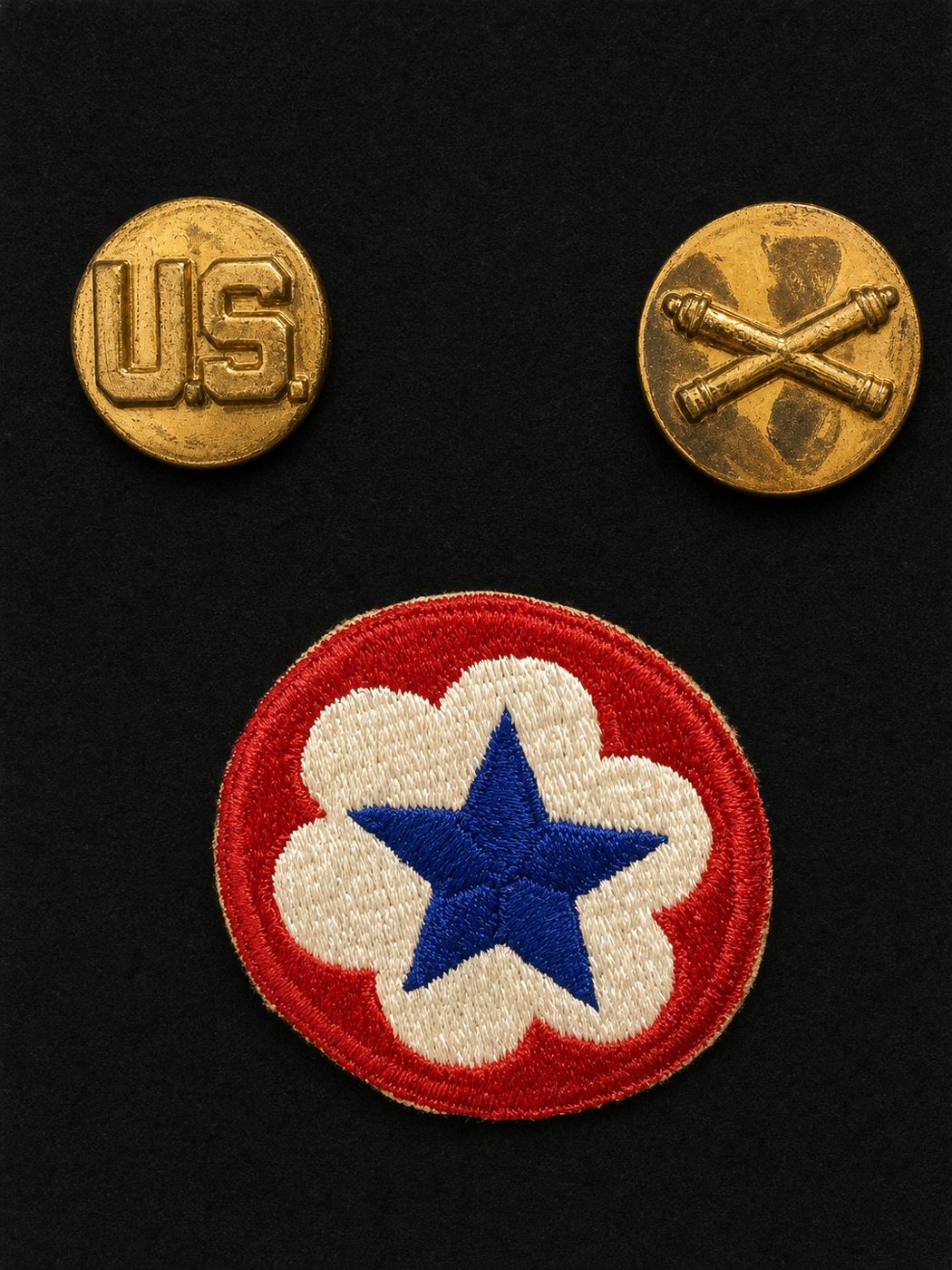
The patch on his left shoulder, the one you can see in the portrait, belongs to the Army Service Forces: a blue star inside a white cloud, ringed in red, taken from the crest of the United States coat of arms. The Service Forces were the part of the Army that moved and supplied everyone else, and the ports of embarkation answered to them.
The collar discs are where the mystery is. One says U.S. The other has two crossed cannons with nothing at the crossing, which is Field Artillery. Military Police wore crossed pistols. So an MP was wearing an artilleryman’s brass. He probably went into the Army as an artilleryman and was moved to MP duty at the port, with the armband marking the job and the disc still marking where he started.
My dad has told me it was his Italian that kept him home. He spoke some. German and Italian prisoners of war came into this country through the Hampton Roads ports, and the Army listed the Norfolk Army Base itself as a prisoner site. A guard who could talk to Italian prisoners was worth something on those piers.
Without the Italian, he was a field artilleryman drafted in 1943. The army that walked into Caianello was full of men like that. He could have been one of them, fighting his way into his own father’s hometown. I will never know. His discharge papers might tell me how he got the armband. They won’t tell me what it kept him from.
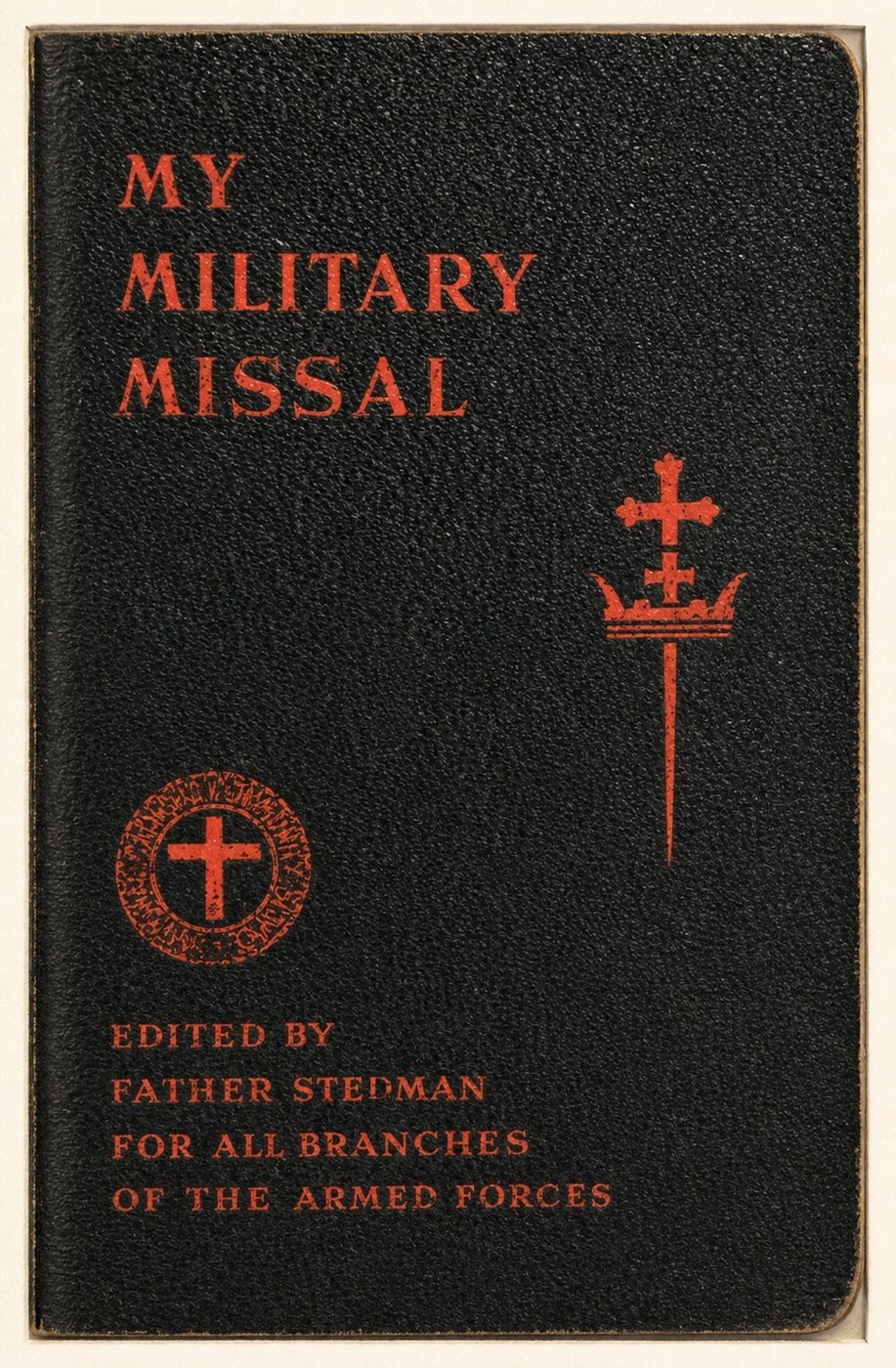
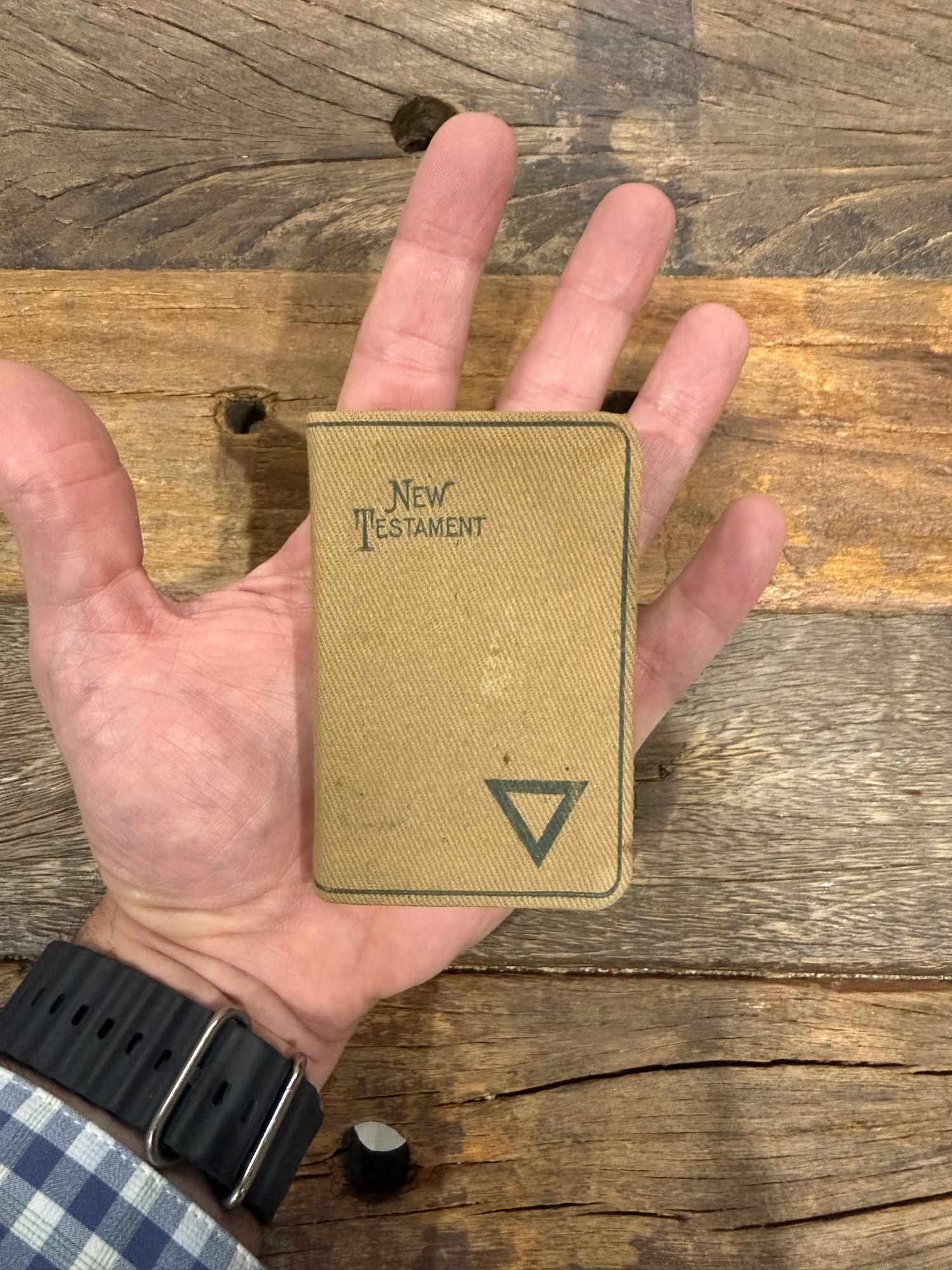
The prayer book is My Military Missal, published in 1942 by Father Joseph Stedman’s Confraternity of the Precious Blood in Brooklyn and handed out to Catholic servicemen through the USO. It fits in a shirt pocket. Inside is a “Mass-Clock,” a chart of the world’s time zones, so a soldier on a pier in Norfolk at two in the morning could see where Mass was being said at that hour and pray along with it.
In a section written to Catholics in the Army and Navy, it tells them, “Give good example as a Catholic gentleman.” The section ends with this: “Pray to live and die as a soldier of Christ.”
That book was his. I don’t know which pages he read. I know he kept it.
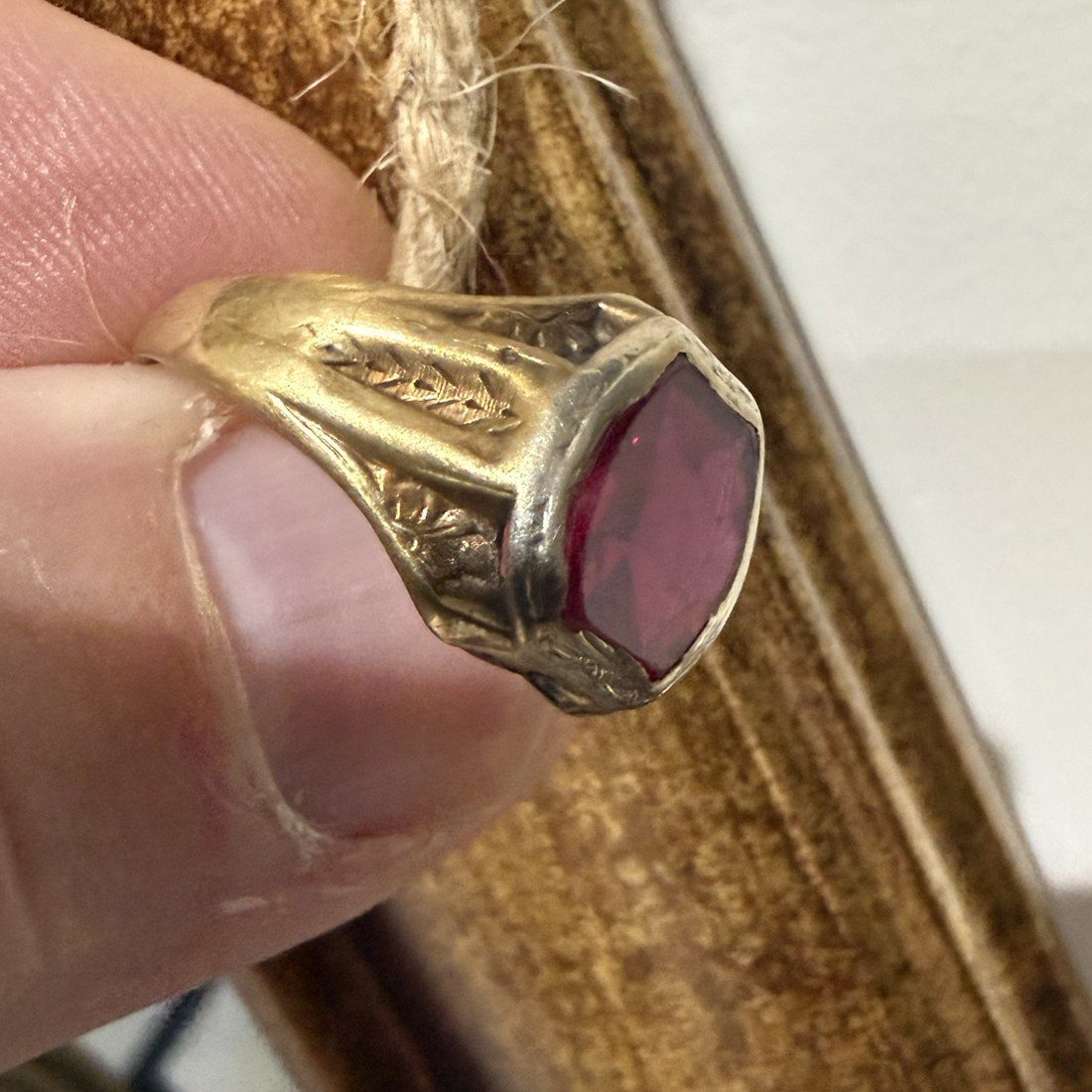
The ring is the one piece I can’t explain. Gold, worn soft at the edges, a red stone set in a bezel, the shoulders cut with a leaf pattern. It is small.
I asked my dad what he knew about it. “Nothing,” he said. “But I remember him wearing it.”
Nobody alive knows where it came from or what it meant to him. My dad remembers it on his father’s hand. That is enough. I didn’t want it behind glass, so it hangs from a rope beside the frame.
He played upright bass in a dance band called the Tunesters. In the one photo I have, five men in tuxedos stand behind music stands with the band’s name across the front. My grandfather is on the far left, beside the bass, grinning. Next to him on drums is Larry Castriotta, his brother Bill’s brother-in-law. Bill is in the middle on steel guitar. Their brother Tom is on saxophone. On the far right, on guitar, is his uncle, Augustino Patalano, his mother Carrie’s brother.
Every man on that stage was family. They played together from 1950 until 1962, the year before he died.
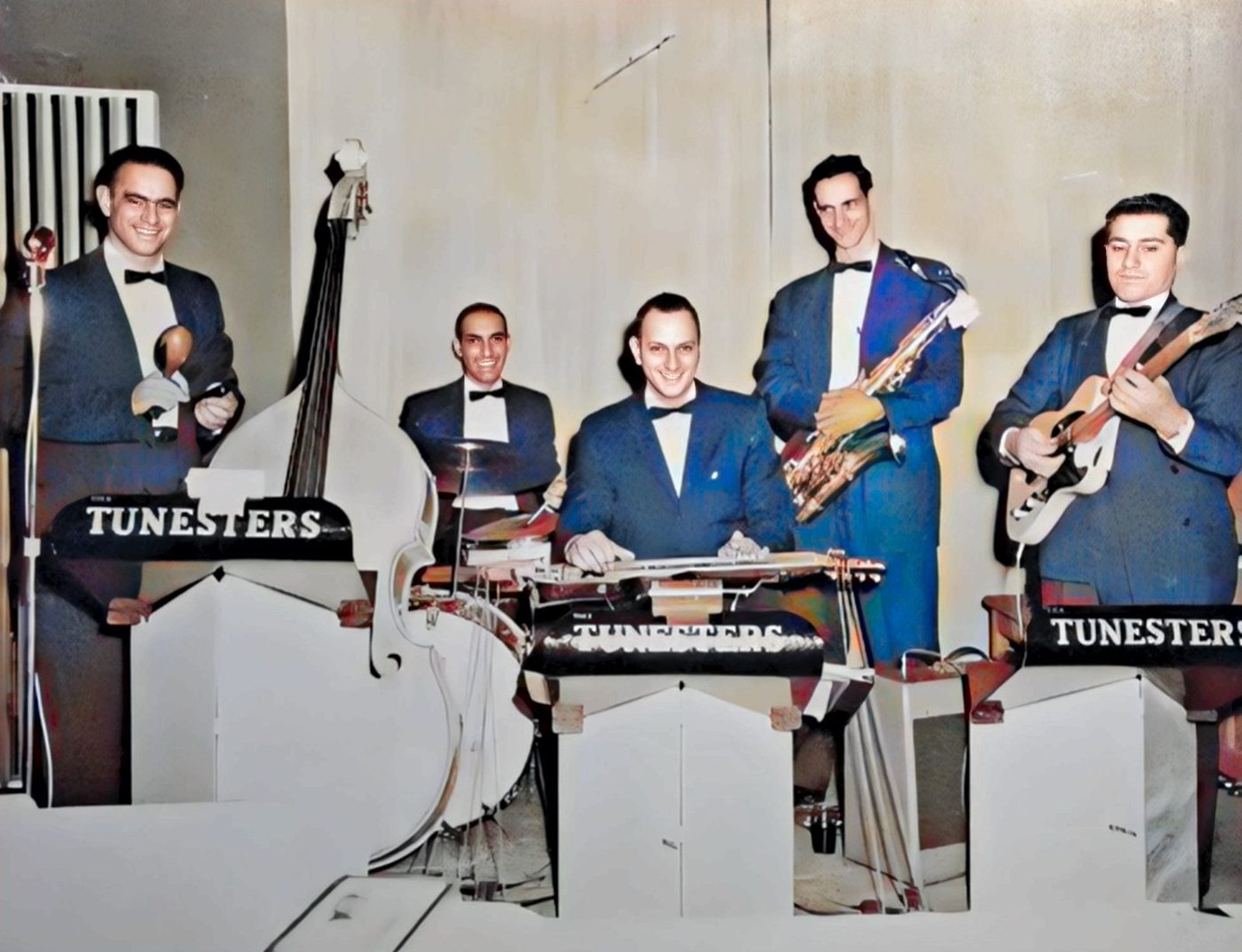
The bass is the offensive line of a band. Nobody claps for it, and everybody notices the second it stops.
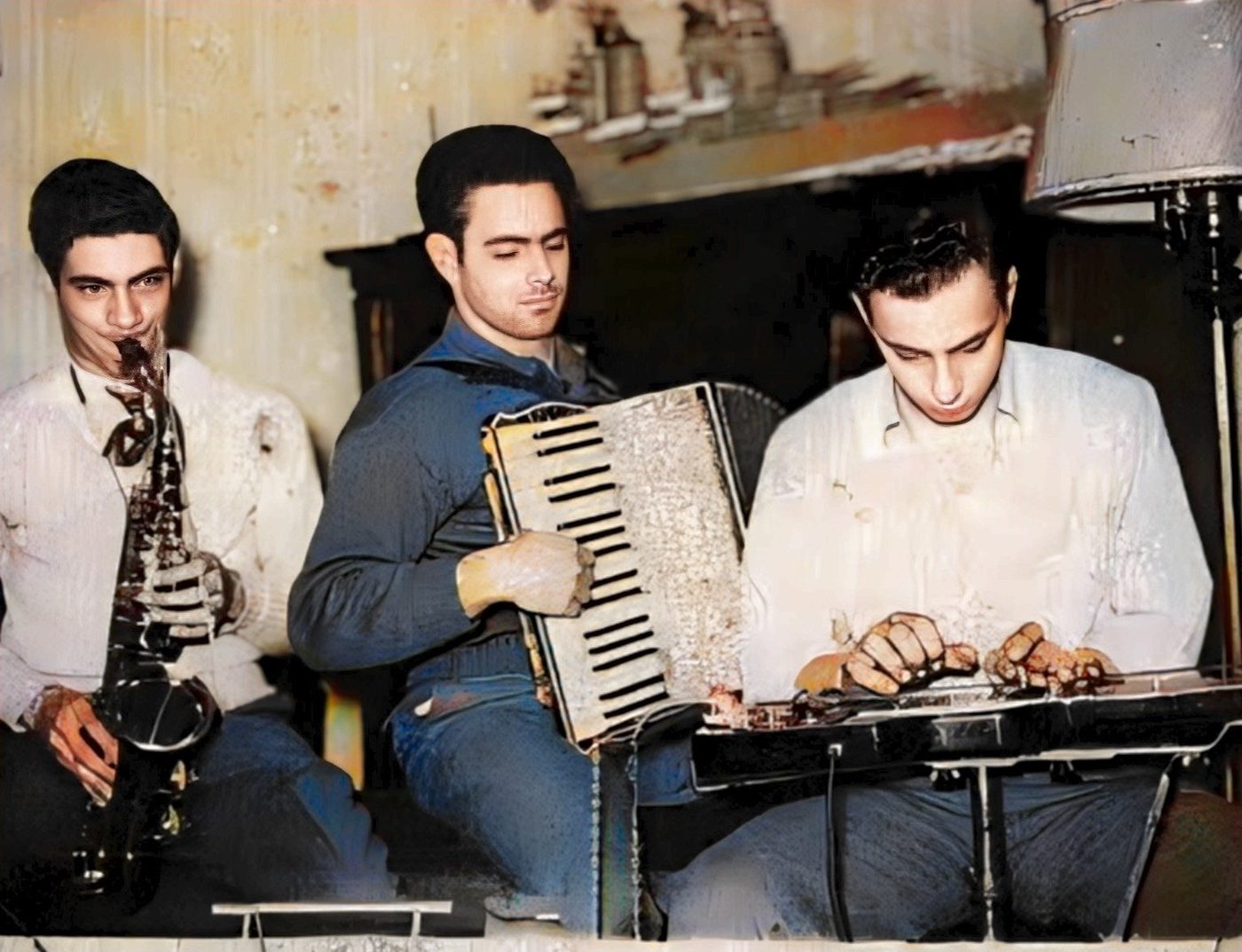
He played the accordion too. In another photo he sits between his brothers, Tom and Bill, all three of them playing. It was a musical house. Tom went on to play in the Marine Corps Band during the Korean War.
John R. Valletta Jr. is buried at St. Ann Cemetery in Cranston, in the family lot with his mother and father. My grandmother Lucy is buried with him.
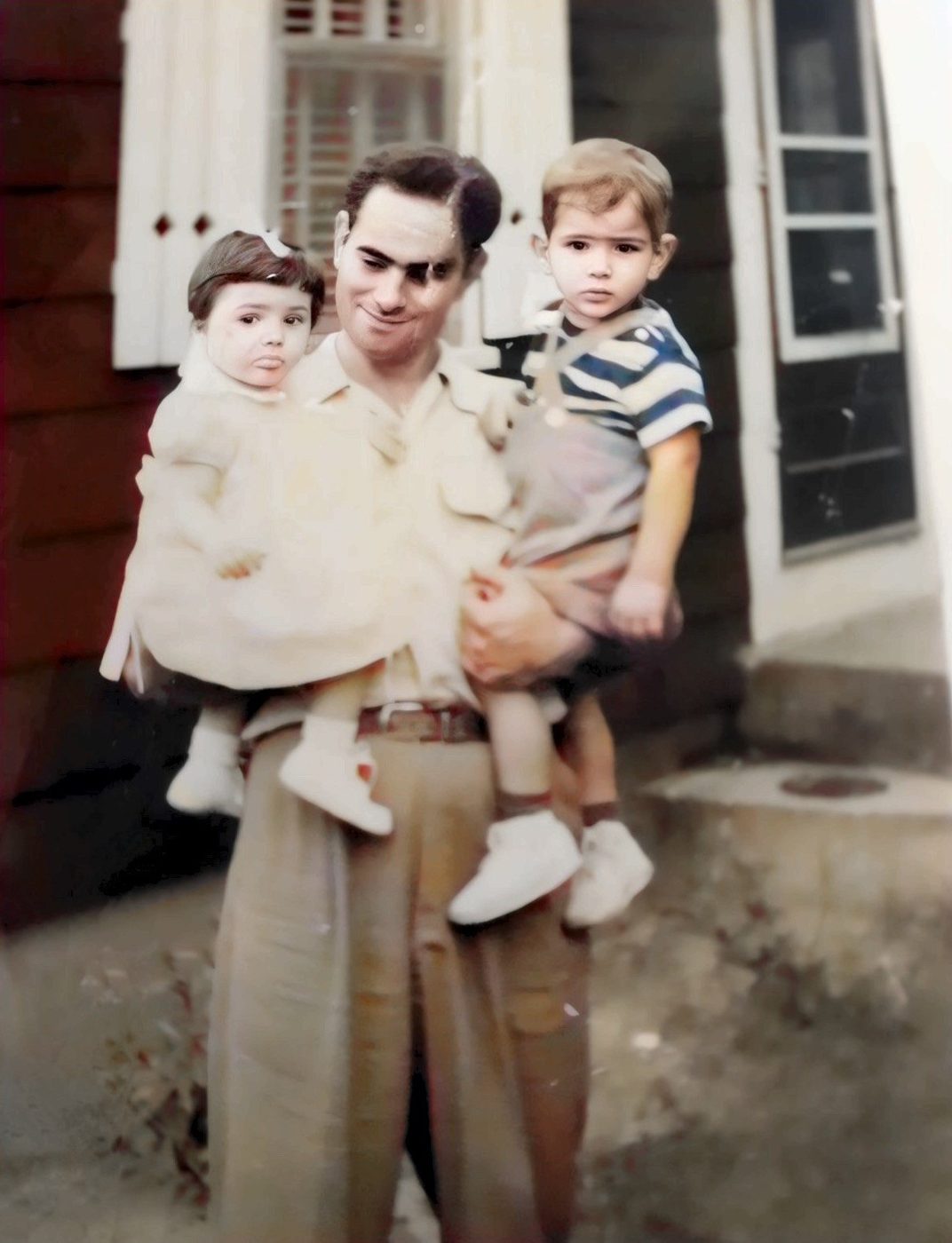
When he died in the summer of 1963, my grandmother Lucy had four children: my dad, my Aunt Sue, my Uncle Dave and my Uncle Mike. My dad was the oldest. He was eleven. His father was not yet forty. That Christmas was the first one without him.
My grandmother Lucy lived almost forty years after him, until 2003.
My dad grew up without a father and became one anyway. Years later, when I started collecting the things soldiers carried, he gave me the things his own father carried. He gave me his father.
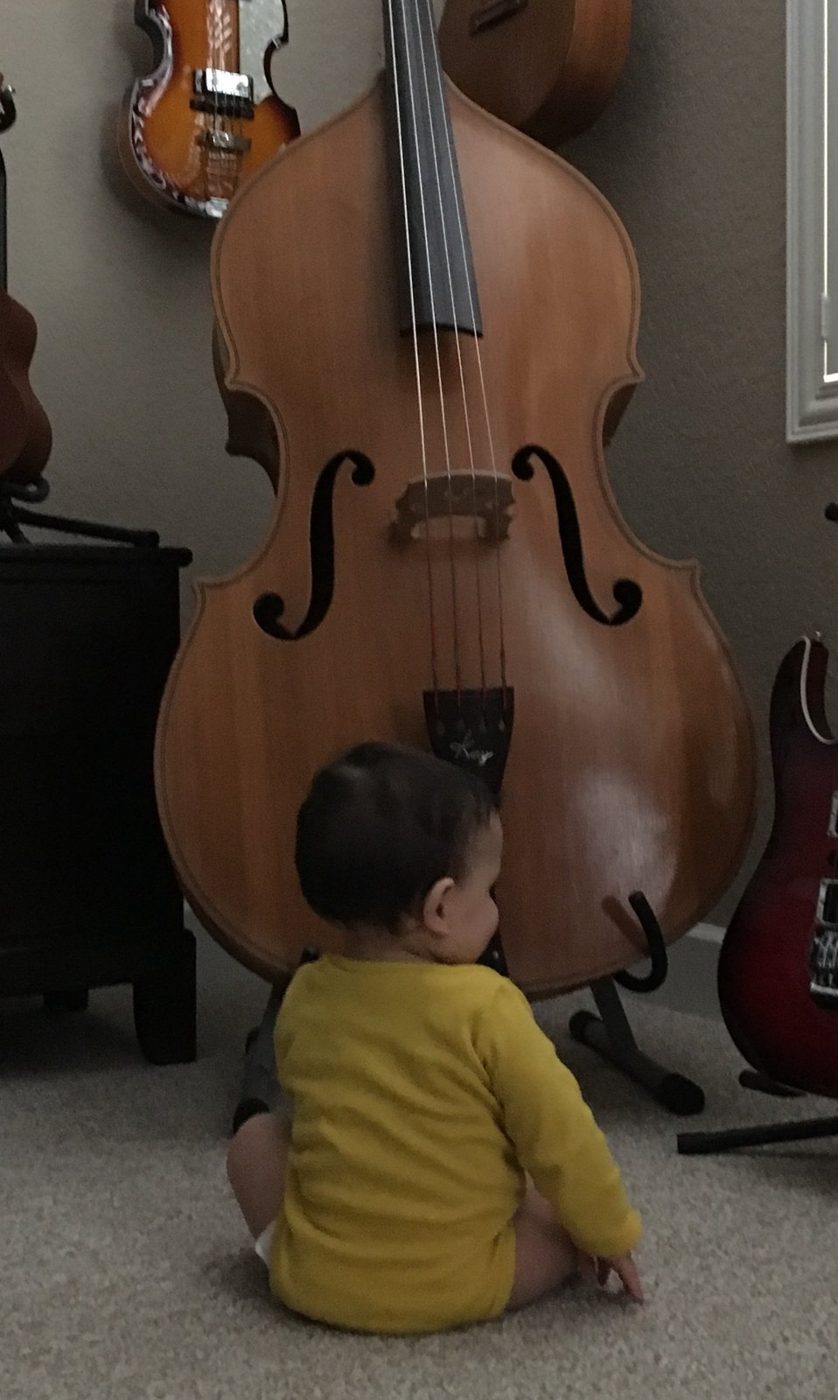
His bass is still in the family. It stands in my mom and dad’s house. It’s a 1952 Kay, built in Chicago. My dad was born that year.
When my younger son, Christian, was a baby, he sat down on the floor in front of it. He never met his great-grandfather either.
I spent my football career at guard and center. The position nobody claps for. The whole job is protecting somebody else so the play can happen. I did not know, until I went looking, that my grandfather spent his war doing his own version of that job, at a gate in Norfolk, for men he would never see again.
That is what leadership is. Service, mostly unseen, for people you may never meet. He served the men going overseas. He served four children he did not get to see grow up. More than sixty years after he died, he is still serving a grandson and a great-grandson he never met.
“The LORD keeps watch over you as you come and go, both now and forever.”
Psalm 121:8 (NLT)
His pass ran out at six the next morning. That promise doesn’t.
The Collection · PDF
Keep this one.
Get “Come and Go” as a printable PDF, with the photographs. Enter your email and it downloads now. You’ll also get the rest of the collection by email, one piece at a time.
Keep reading
More from the writing
Bring this to your team.
Check availability